Part 2 of the “Chronicles of Scent in Antiquity” Series
“Each part of the day belongs to a god. And when the sun sets, the realm of Osiris begins.”
— Temple inscription, Ptolemaic Period
A Fragrant Offering for the Dusk
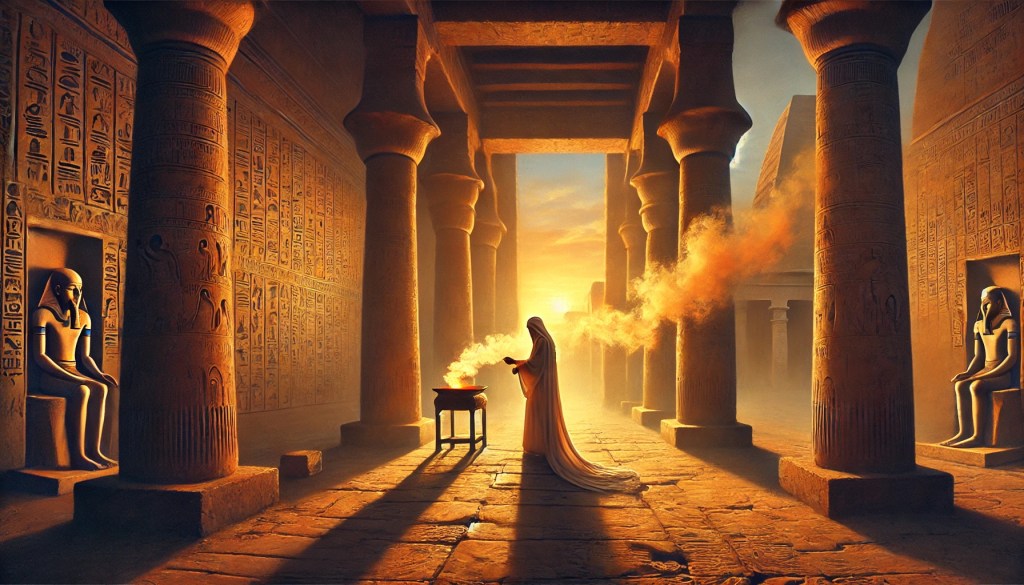
The setting sun in ancient Egypt did not merely mark the end of the day—it signaled a shift in the spiritual world. Day belonged to the sun god Ra, but night was the domain of Osiris, god of the afterlife and rebirth. At this liminal moment, when light gave way to darkness, a priest stepped into the inner sanctum, lit a small flame, and began to burn Kyphi.
This was not casual incense. Kyphi was reserved exclusively for the evening ritual, known in Egyptian as “senetjer”, or “to make divine.” It was a central element of the daily temple liturgy, performed three times a day: at dawn, noon, and sunset. But only at sunset was Kyphi used—its rich, layered scent meant to prepare both the gods and the humans for the transition into night.
Inside the Temple: Precision, Purity, and Perfume
Egyptian temples were not public places of worship but homes for the gods, tended by an elite priesthood. Each day, priests performed a strict sequence of rites, including cleansing statues of deities, anointing them with oils, dressing them in fine linens, and offering food, drink, and incense.
Before entering the sanctuary, the priest had to undergo ritual purification—including bathing, shaving body hair, and donning clean linen robes. As the final act of devotion, incense was burned to please the god’s senses and spiritually “seal” the ritual.
Kyphi, with its rare ingredients and complex preparation, was a fragrance of the highest order, reserved for these most sacred moments. The thick, sweet-smoky aroma was believed to:
- Purify the air and space
- Appease deities and invite their presence
- Elevate the soul and prepare for dreams or visions
The Sunset Liturgy: A Sacred Schedule
In temples like those at Karnak, Dendera, and Edfu, the daily ritual followed a consistent rhythm:
- Dawn – Opening of the sanctuary, burning of frankincense
- Midday – Offerings of myrrh and fresh linens
- Sunset – Kyphi incense burned in silence and reverence
Plutarch, the 1st-century CE philosopher, wrote that Kyphi’s association with evening reflected its relaxing and cleansing nature. He described it as:
“…a compound that promotes sleep and serenity, useful after the business of the day has passed.”
This aligns with how the Egyptians may have viewed Kyphi—not only as a divine offering, but as a way to close the day with spiritual balance and peace.
Smoke as a Pathway to the Divine
To the ancient Egyptians, scent had a direction—smoke rose upward, carrying prayers, thoughts, and life force toward the heavens. The temple was built as a microcosm of the universe, and incense acted as the bridge between worlds.
Burning Kyphi at sunset symbolized a shift into the mystical, nocturnal realm—a time of dreams, death, and renewal. In this sense, it was more than scent; it was theology in vapor form.
Even the word for incense (senetjer) meant “to make divine.” The act of burning Kyphi was not just ritual—it was a transformation, of space, time, and spirit.
From Ritual to Rhythm: Why This Still Matters
Understanding Kyphi’s role in temple rituals allows us to see fragrance not just as aesthetic, but existential. It reveals a civilization that believed scent could order time, elevate consciousness, and invite divinity.
In an age where we rush through our days, the ancient Egyptians remind us:
The day is not complete without sacred closure.
Kyphi was that closure—a breath between this world and the next.
Coming Next:
Part 3 – “Kyphi Reborn: How Modern Perfumers Recreate a Lost Sacred Blend”
 The Aromatic Journey
Leave a comment