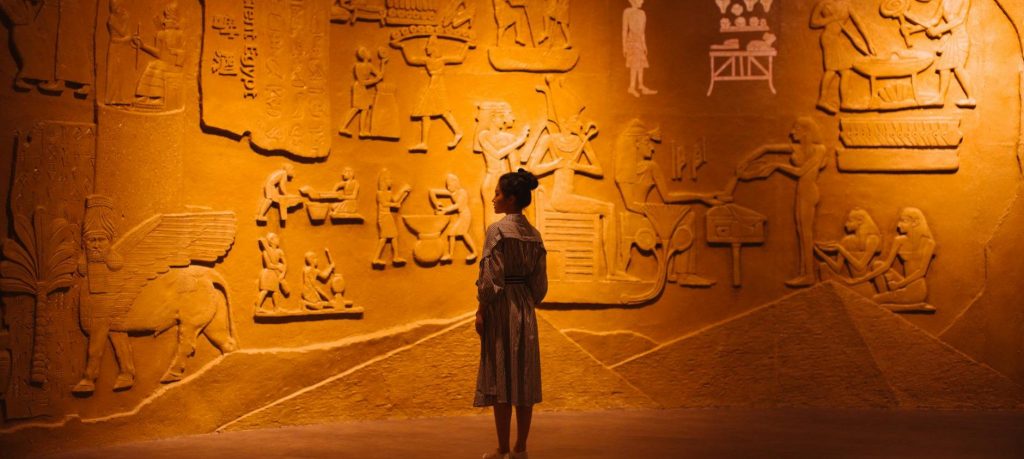
Chronicles of Scent in Antiquity – Final Installment
“Fragrance has no shape, yet we remember time and awaken emotions through its breath.”
Kyphi Is Not a Forgotten Scent
Throughout this series, we’ve traced the sacred trail of Kyphi—from its ancient temple origins to modern reconstructions, its medicinal virtues to its spiritual uses.
But one final question remains:
Is Kyphi merely a relic of the past?
Or could it still be relevant—breathing—in our modern world?
The answer, much like scent itself, lingers in the air.
A Cultural Fragrance Beyond Egypt
Kyphi was more than a ritual incense; it was a cultural statement.
Its use extended beyond Egypt into Hellenistic and Roman religious practices, where it inspired philosophies of spiritual cleansing and sensory transformation.
Plutarch himself praised Kyphi for its ability to “brighten dreams and soothe the soul.”
It was never just about smoke—it was about a way of being:
gathering natural ingredients, preparing them with care, and using scent as a tool to align with oneself, with the gods, and with time itself.
Scent in Art, and the Art of Memory
Scent is invisible, yet unforgettable.
Unlike visual art or sculpture, it leaves no trace, but instead lives in memory.
Kyphi, in its richness and depth, is an olfactory metaphor for memory itself.
A whiff of something sweet and resinous can suddenly carry us back to childhood, a forgotten ritual, or an emotion we didn’t know we had buried.
In ancient Egypt, Kyphi wasn’t just burned to honor the gods—it was used to keep souls remembered, echoing the belief that to be remembered is to live forever.
Kyphi Reimagined: Sacred Scents in Modern Life
Today, Kyphi lives on in surprising and beautiful ways:
- In meditation rooms and yoga studios, burned before stillness and silence
- Reimagined in niche perfumes under names like “Sacred Resins” or “Temple Smoke”
- Incorporated into digital wellness platforms for emotional balancing
- Used in art therapy and grief healing ceremonies
- Offered in modern ancestral rituals, where scent replaces spoken prayers
Some modern perfumers and therapists even design Kyphi-inspired formulas as “fragrant mindcare tools,” merging ancient intent with modern wellness science.
Kyphi and the Question of Sustainability
Most of Kyphi’s ingredients—frankincense, myrrh, cinnamon—are precious botanicals, often sourced from regions facing climate stress and overharvesting.
Reviving Kyphi today invites us to reflect not only on ancient ritual, but on ethical sourcing, botanical conservation, and sustainable fragrance practices.
Kyphi was born from nature, shaped by human hands, and offered to the divine.
Perhaps its truest legacy is reminding us that healing begins with harmony—with the earth, the body, and the spirit.
A Scent That Still Breathes
Kyphi is not lost.
It’s a living echo—of ancient hands grinding herbs, of sacred fire illuminating stone walls, of memory drifting gently through the air.
And perhaps… when you light a piece of incense tonight,
a priest from 3,000 years ago did the same—beneath the same sky, with the same quiet intention.
References
- Plutarch, On Isis and Osiris
- Lise Manniche, Sacred Luxuries
- Manniche & Allen, Kyphi: The Sacred Perfume of Ancient Egypt
- UNESCO Fragrance & Intangible Heritage Reports
- Journal of Cultural Heritage (2022), “Fragrance, Memory, and Identity”
 The Aromatic Journey
Leave a comment