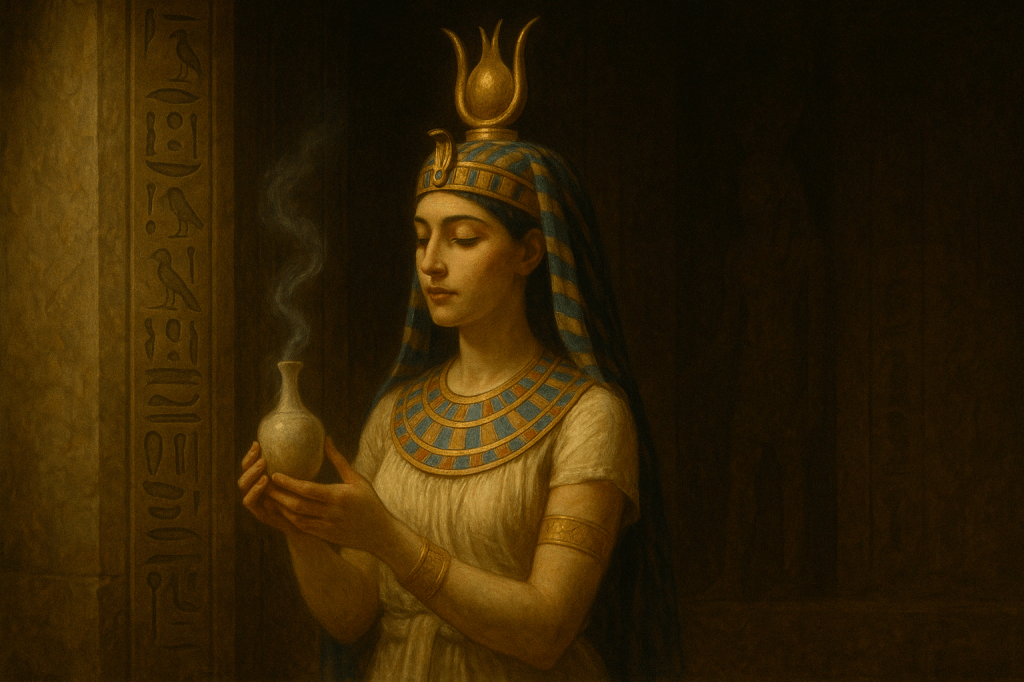
In ancient Egypt, scent was more than a luxury — it was identity.
To wear fragrance wasn’t simply to smell pleasing; it was to declare who you were, what you believed, and whom the gods had favored.
For women, especially, scent was an extension of their presence — spiritual, social, and sensual. Whether queen or priestess, noble or merchant, a woman’s fragrance said as much about her status as her jewels or her lineage. And in some cases, it spoke louder.
From birth, Egyptian girls were introduced to scented rituals: oils for protection, cleansing, and blessing. Mothers would anoint their daughters with drops of perfumed myrrh or lotus oil behind the ears, just as their own mothers had done. These weren’t merely maternal gestures — they were rites of passage, deeply woven into the spiritual fabric of society.
Scent marked transitions: birth, coming-of-age, marriage, even death. Perfumed ointments were applied before weddings, before temple visits, before seduction. A woman entering a sacred space would be cleansed with scented oils not for decoration, but to be made worthy of divine proximity. Fragrance, in this sense, was purification — a bridge between the human and the divine.
But perfume was also political.
High-born women often had access to rare, imported ingredients — Syrian cedarwood, Nubian frankincense, incense from Punt. These fragrances weren’t just expensive — they were exclusive, signaling power and reach. Temple dancers and female musicians, often employed by elite households or deities themselves, were trained in the art of scent application — each oil meant for a different effect, mood, or ritual hour.
And then there were the queens.
For Cleopatra, scent was seduction and statecraft.
For Nefertiti, it was divine order and aesthetic harmony.
For Hatshepsut, it was spiritual legitimacy and temple rule.
All of them used scent as a tool — not only of femininity, but of agency. In a society often seen through a patriarchal lens, these women used fragrance to shift perception, project authority, and encode their presence into the senses of everyone around them.
Even ordinary women understood the power of olfactory impression. Papyrus fragments contain household recipes for home-blended oils — lily, henna, fenugreek, and honey. These formulas, passed from mother to daughter, were often closely guarded. To share one’s perfume recipe was to share a part of one’s identity.
And when death came, it came wrapped in scent.
Female mummies were prepared with the same reverence as queens: bathed in aromatic oils, wrapped in linens soaked in resins, laid to rest in chambers filled with scented jars. The belief was simple yet profound — if you entered the next life perfumed, you arrived as someone divine.
So when we speak of ancient Egyptian women, we must speak of scent.
Not as accessory, but as power. Not as ornament, but as language.
Fragrance was their breath of divinity — their signature in a world that didn’t always write their names, but remembered how they smelled.
 The Aromatic Journey
Leave a comment