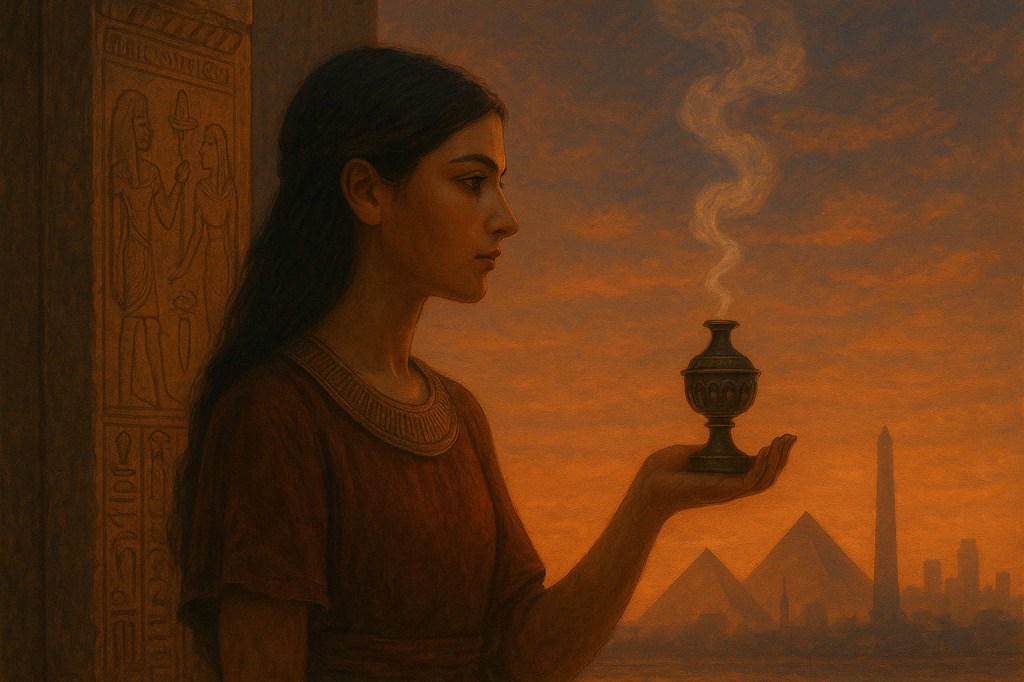
Fragrance has always been memory.
It’s the invisible thread that ties us to people, places, and even entire civilizations. From Cleopatra’s perfumed sails to Kyphi rising in temple smoke, scent has long been both ephemeral and eternal.
But what does fragrance mean today?
In an era defined by climate crisis, digital transformation, and a growing desire for meaning, the ancient language of scent is being reborn — more consciously, more creatively, and more connected than ever.
Today’s perfumers are looking backward as much as forward.
There’s a renewed interest in ancient ingredients — myrrh, frankincense, blue lotus, cedarwood — not just for their aroma, but for their stories. Modern brands are collaborating with archaeobotanists, historians, and even museums to recreate lost scents of the ancient world. Some even reconstruct them molecule by molecule from residue found in tombs and vessels.
But it doesn’t stop there. The future of fragrance is also about sustainability.
The most prized aromatic ingredients — like sandalwood or oud — are often endangered.
Extraction processes for florals and resins can be resource-intensive and exploitative.
And so, a new generation of creators is turning to biotechnology, lab-grown molecules, and sustainable sourcing to preserve both nature and narrative.
What was once burned as sacred incense is now analyzed in AI-driven scent labs.
Digital olfaction, or the idea of encoding scent into data and reproducing it electronically, is no longer just science fiction. Startups are working on “scent printers” and immersive fragrance experiences powered by algorithms and smart diffusers. In the not-so-distant future, we might experience Cleopatra’s favorite perfume through virtual reality — or send a memory of our childhood garden as a digital scent message.
And yet, even in the age of technology, fragrance remains deeply human.
We still apply perfume before important moments. We still keep a bottle that reminds us of someone who left. We still choose scents not only for how they smell, but for how they feel.
Perhaps the most powerful evolution of fragrance is this:
We no longer wear scent only to be perceived — we wear it to remember ourselves.
Just like the queens of Egypt, modern individuals use fragrance to express identity, protect their energy, and tell untold stories.
The tools may have changed. The rituals may have evolved.
But the meaning — the yearning to connect, to transcend, to matter — remains the same.
Fragrance is no longer just the final touch.
It’s becoming the beginning of a story — one that bridges the wisdom of the past with the possibilities of the future.
And in that sense, the scent of ancient Egypt lingers still.
Not just in museums or formulas, but in every drop we choose to carry forward.
 The Aromatic Journey
Leave a comment