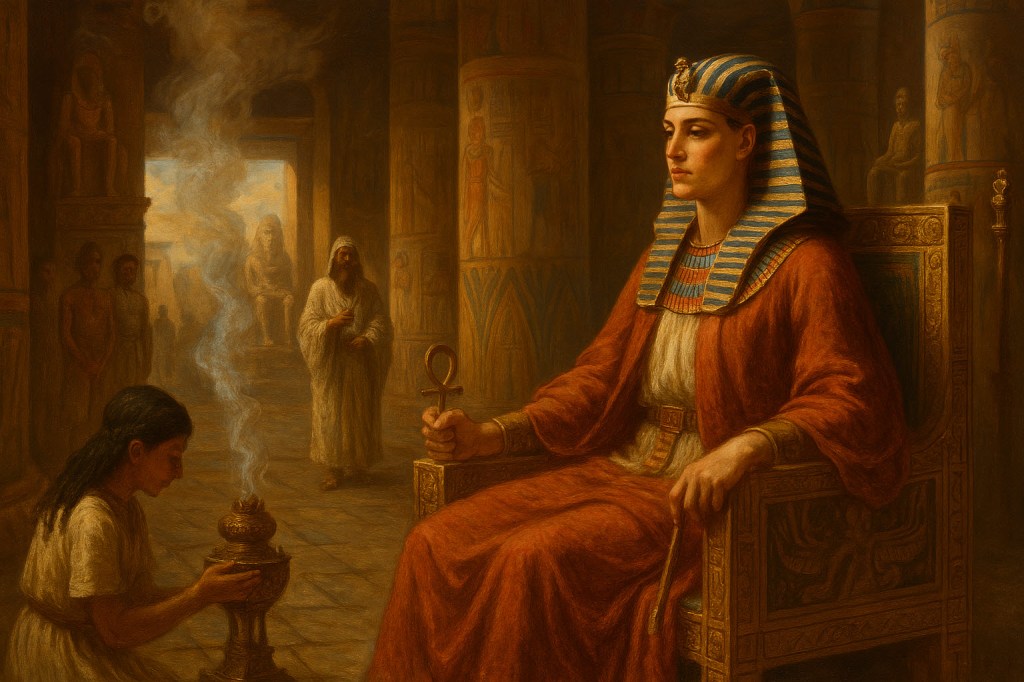
• Hatshepsut: The Queen Who Became Pharaoh, Cloaked in Sacred Scents

    A story of incense, power, and the divine femininity of Egypt’s forgotten ruler

    In the heart of ancient Thebes, long before Cleopatra seduced Rome and before Nefertiti redefined elegance, a woman dared to do the unthinkable — she became Pharaoh. Not queen, not consort. Pharaoh.

    Her name was Hatshepsut.
    And her rule, scented with sacred incense and cloaked in divine authority, remains one of the most fascinating chapters in Egypt’s history.

    Born to Pharaoh Thutmose I and Queen Ahmose, Hatshepsut was not meant to rule. But when her husband-brother Thutmose II died, and her stepson was still a child, she stepped into power — slowly at first, as regent. Then, boldly, as Pharaoh in her own name.

    She didn’t disguise herself as a woman. She transcended gender. Wearing the traditional false beard of a king and royal male garb, she commissioned grand monuments, expanded trade, and restructured religious practices — all while reinforcing that her rule was ordained by the gods.

    But her power wasn’t just in temples and politics.
    It was also in scent — specifically, in incense.

    Hatshepsut’s most ambitious journey was the legendary expedition to the Land of Punt, a distant and mysterious region believed to lie in the Horn of Africa. She sent fleets not to conquer, but to trade. Their most prized cargo?
    Frankincense trees. Myrrh. Cinnamon. Exotic resins.

    She didn’t just bring back incense — she brought back the source. Her temple at Deir el-Bahari, nestled beneath the cliffs of western Thebes, is adorned with carved scenes of this voyage. Inscriptions detail the trees being planted in the temple gardens — the first recorded botanical transplant in history.

    Why was incense so important?

    In ancient Egypt, incense was more than aroma. It was a conduit to the divine. Burned in temples during rituals, it purified space, summoned deities, and embodied the breath of the gods. To command incense was to command the sacred.

    By controlling the incense trade and planting it within the temple itself, Hatshepsut wasn’t just importing scent.
    She was anchoring her reign in spiritual legitimacy — making her rule inseparable from the divine.

    This move was brilliant. Political. Theological. Sensory.
    A queen turned king, perfumed in sacred smoke.

    Even the architecture of her temple evokes this sensual sacredness: open courtyards bathed in sunlight, smooth limestone walls echoing chants, and faint trails of myrrh and kyphi (a temple blend of resins, honey, and wine) rising into the desert sky.

    Yet after her death, her memory was nearly erased — statues defaced, her name chiseled out. Historians long believed this was done by her jealous stepson, but modern research suggests it may have been a calculated political move to restore dynastic clarity.

    But memory, like scent, lingers in the air long after the source is gone.

    Today, Hatshepsut is celebrated as one of history’s first great female rulers — a leader who used not only power and architecture, but the deep magic of perfume and ritual, to shape her empire.

    Her story reminds us:
    True authority doesn’t always roar. Sometimes, it rises slowly — like incense — and fills the world with something unforgettable.

    Love stories like this?
    My new digital book Eternal Queens explores the sacred scent rituals of Egypt’s most powerful women—Cleopatra, Nefertiti, and Ankhesenamun—through history, myth, and modern blends.
    🌿 Includes printable ritual cards and fragrance recipes.
    👉 Download it now

    Coming Next: “Ancient Scents & Beauty Rituals: Oils, Powders, and Perfumes of the Nile”
    👉 Dive into the natural ingredients and sacred blends behind Egyptian beauty and wellness.

  • Nefertiti: The Divine Face of Ancient Beauty

    Nefertiti.
    Her name means “the beautiful one has come,” and more than 3,000 years later, her legacy still echoes with grace, mystery, and the timeless allure of beauty.

    She ruled beside Pharaoh Akhenaten during Egypt’s Amarna Period, a time of radical spiritual transformation. But it wasn’t just religion she helped shape — it was also the visual ideal of feminine power, elegance, and poise. While her famous bust, discovered in 1912 and now displayed in Berlin’s Neues Museum, is often seen as the epitome of ancient perfection, Nefertiti was more than a pretty face. She was a queen, a high priestess, a co-ruler — and most likely, a political force in her own right.

    And at the center of her identity? Scent. Skin. Presence.

    In ancient Egyptian culture, beauty was not a luxury — it was sacred. Both men and women adorned themselves with makeup, perfume, and skincare oils not merely for appearance, but for health, ritual, and divine favor. Nefertiti, as both queen and high priestess, would have been immersed in this culture daily.

    Historical records and archaeological findings suggest that she likely used a variety of natural oils and herbs. Her beauty ritual would have included:

    • Black kohl eyeliner, not only for dramatic effect but to protect against the sun and evil spirits
    • Red ochre and carmine pigments for lip and cheek coloring
    • Frankincense-infused facial oils to soften and perfume the skin
    • Moringa oil, known for its anti-aging properties, used in daily skincare
    • Lotus flower extract, revered for its spiritual and sensual qualities

    The royal family even had private perfume workshops, where oils were blended with herbs like myrrh, cinnamon, cardamom, and rose petals. These weren’t simply used to smell good — they were tied to religious ceremonies, fertility rites, and even political diplomacy.

    The combination of healing, seduction, and spirituality made scent a powerful symbol of divine right. And Nefertiti, whose image was worshipped in temples, would have embodied this synthesis of beauty and the sacred.

    Some Egyptologists believe that Nefertiti may have ruled Egypt under the name Neferneferuaten after Akhenaten’s death. If true, she would be one of the few female pharaohs in history — alongside figures like Hatshepsut and Cleopatra. Her visual legacy, immortalized in the iconic limestone bust, shows a queen who knew the power of appearance and controlled it with precision.

    And yet, like a delicate perfume trail lingering in the air, the truth of her full story remains elusive. Her tomb has never been found, and her final years remain one of ancient Egypt’s greatest mysteries. But what we do know is this: her influence endures.

    Today, Nefertiti’s name appears in modern beauty products, museum exhibits, art, and even fashion. Her image — symmetrical, strong, serene — remains a gold standard of grace.

    When we apply eyeliner, blend floral oils on our skin, or light incense in ritual, we’re unknowingly echoing traditions she helped define. Through scent and self-presentation, Nefertiti wrote herself into history — not just as a queen, but as a symbol.

    A symbol of what happens when beauty is not weakness, but wisdom.

    Love stories like this?
    My new digital book Eternal Queens explores the sacred scent rituals of Egypt’s most powerful women—Cleopatra, Nefertiti, and Ankhesenamun—through history, myth, and modern blends.
    🌿 Includes printable ritual cards and fragrance recipes.
    👉 Download it now

    Coming next in the series:

    “Hatshepsut: Pharaoh, Priestess, Perfume – The Queen Who Became King”
    👉 Meet the queen who ruled as a man and scented her reign with sacred incense.

  • Cleopatra’s Perfume: The Scent of Seduction and Strategy

    Cleopatra, the last queen of Egypt, was far more than a beautiful face in history. She was a master strategist, a linguist fluent in nine languages, and above all, a ruler who understood the subtle yet immense power of the senses. Among them, scent was her secret weapon.

    In an era where politics was often defined by brute force and masculine dominance, Cleopatra chose a different battlefield—one scented with myrrh, lotus, cinnamon, and frankincense. Her perfumes weren’t just about attraction. They were about identity, seduction, and sovereignty. She crafted her own fragrance blends with the help of court perfumers, using ingredients that were both luxurious and symbolic—frankincense for divinity, lotus for sensuality, and myrrh for mystery. These were not simply perfumes; they were declarations of power.

    Historical texts, like those of Plutarch, tell us of the moment Cleopatra first met the Roman general Mark Antony. She arrived by barge, its sails soaked in perfume, with rose and lotus scents wafting through the Nile breeze before her presence even came into view. It was said the scent of Cleopatra arrived before she did. Imagine the anticipation that fragrance alone could create—an olfactory herald of a queen. It was her way of making an entrance, of marking her territory—not with a sword, but with a cloud of intoxicating scent.

    Cleopatra aligned herself with the goddess Isis, presenting herself not just as a queen but as divine. In ancient Egypt, scent was sacred. Perfumes were offered to gods, used in temples, and worn by royalty to signal status and connection to the divine. To wear a scent was to hold power. And Cleopatra, more than anyone, knew how to wield that.

    Modern scientists and archaeologists have tried to recreate her perfumes based on residues found in 2,000-year-old perfume vessels uncovered near the ruins of ancient perfumeries. Through these studies, we’ve learned that Cleopatra’s signature scents were thick, long-lasting perfumed oils made with olive oil bases and blended with resins and spices. These were nothing like the airy floral sprays we know today—they were deep, intense, and unmistakably exotic.

    Her mastery over the senses turned fragrance into a political language. Her scent wasn’t just for seduction; it was a message. To her lovers, it whispered enchantment. To her enemies, it signaled power cloaked in elegance. To history, it left a trail that lingers even now.

    When we think of Cleopatra today, we remember not only her beauty or her legendary affairs with Caesar and Antony, but her ability to rule a kingdom, captivate an empire, and write herself into history—one drop of perfume at a time.

    Love stories like this?
    My new digital book Eternal Queens explores the sacred scent rituals of Egypt’s most powerful women—Cleopatra, Nefertiti, and Ankhesenamun—through history, myth, and modern blends.
    🌿 Includes printable ritual cards and fragrance recipes.
    👉 Download it now

    Coming Next in the series:
    Nefertiti: The Divine Face of Ancient Beauty

  • Fragrance and Legacy

    Part 7 of the “Scent and the Roman Empire” Series

    The Roman Empire may have fallen, but its scent still lingers.

    From sacred temples to perfumed bathhouses, the Romans created a culture of fragrance that was as sophisticated as it was pervasive. But what happened after Rome fell? Did the scents fade into history?

    Not quite.

    In the centuries that followed, Roman practices were preserved, adapted, and revived. In medieval Europe, monastic communities became the guardians of ancient herbal knowledge. They transcribed Roman and Greek medical texts and prepared aromatic remedies using methods such as steeping herbs and flowers in oils, wine, or vinegar. While true steam distillation was later developed and refined in the Arabic world—most notably by the Persian scholar Avicenna—monks crafted scented herbal waters and tinctures used for healing and spiritual clarity, echoing Rome’s philosophy that scent touched both body and soul.

    During the Renaissance, interest in Roman antiquity reawakened. Artists painted bath scenes inspired by Roman frescoes. Apothecaries rediscovered texts by Pliny, Galen, and Dioscorides, reintroducing their botanical wisdom into early pharmacology. Catherine de’ Medici’s court in 16th-century France helped birth modern perfumery—built upon the trade networks and plant knowledge that Rome had once dominated.

    Even the idea of personal scent as identity and power, so central to Roman elites, survived and evolved. In Baroque and Enlightenment Europe, perfume was again tied to status, health, and seduction—just as it had been in the empire.

    Today, as the world rediscovers natural wellness, aromatherapy, and mindful living, we are, in a way, returning to Rome. The modern essential oil movement borrows heavily from Roman and Greco-Arabic traditions. Whether it’s lavender for sleep, myrrh for the skin, or rose for emotional balance—the recipes are ancient, but the relevance is new.

    But there is something Rome did not face that we must: the sustainability of scent.

    The Romans never had to worry about deforestation of sandalwood, overharvesting of frankincense, or synthetic fragrance toxicity. Today, ethical sourcing, biotechnology-based scent development, and cultural respect for origin plants have become central to the fragrance industry.

    Still, the Roman philosophy of fragrance remains: That scent is not just a luxury, but a language. Not just a product, but a ritual. Not just a smell, but a story.

    And that story continues—with us.

  • Fragrance and Medicine

    Part 6 of the “Scent and the Roman Empire” Series

    Long before the invention of antibiotics or antiseptics, Romans turned to aromatic herbs, resins, and oils to heal wounds, calm the mind, and purify the body. In temples, homes, and bathhouses, the air was often laced with the scents of herbs, flowers, and resins believed to carry medicinal power.

    One of the greatest physicians of antiquity, Galen of Pergamon, wrote extensively about such remedies. In his treatise De Simplicium Medicamentorum, he described how myrrh reduced inflammation, how nard and cinnamon stimulated circulation, and how rose-infused oil—made by steeping rose petals in olive oil—was used to cool fevers and ease skin irritations. Galen didn’t separate medicine from scent. To him, aroma was part of the physician’s arsenal.

    Pliny the Elder, in his Natural History, went even further—cataloging over a hundred aromatic substances used for healing. He praised the use of juniper and laurel smoke to disinfect rooms and ward off disease. Basil, according to Pliny, could chase away sadness if rubbed on the temples. Even scented vinegars, steeped with herbs and petals, were used to treat fatigue, nausea, or melancholy.

    In Roman daily life, healing with scent was often practiced at the public baths, where ritual and medicine overlapped. After cleansing in hot and cold pools, bathers were massaged with herbal unguents—thick oils perfumed with thyme, marjoram, lavender, or sage. These weren’t just cosmetic. Romans believed such scents helped balance the body’s humors, ward off illness, and support longevity.

    Lavender, in particular, was popular for its calming and cleansing properties. Its very name comes from the Latin lavare—“to wash.” While true distilled essential oils didn’t exist yet, Romans used lavender-infused oils in baths, on linens, and even to clean wounds. Roman soldiers were said to carry small jars of herbal salves on campaign, using them to treat cuts, blisters, and infections.

    Fragrance also played a powerful role in end-of-life rituals. The bodies of the deceased were washed with rose or myrrh-scented water, then wrapped in aromatic cloths before burial. This wasn’t just symbolic. The scent served to honor the soul, purify the remains, and perhaps ease the journey to the next world.

    And finally, there was the mind. Romans deeply believed that certain aromas could shift emotional states. The poet Horace described saffron as uplifting, myrtle as clarifying, and rose as soothing to the heart. In a culture where physical and spiritual wellness were intertwined, fragrance was medicine for both body and soul.

    In ancient Rome, healers and perfumers shared common ground.
    Their tools were plants, oils, and knowledge.
    Their goal was the same: to restore balance—and leave behind a trace of beauty.

    Coming Next: Fragrance and Legacy: The Enduring Influence of Roman Scent Culture

  • Part 5 of the “Scent and the Roman Empire” Series

    The power of Rome didn’t just flow from its legions—it floated on the air, carried by the scent of empire.

    In the Roman world, fragrance was a commodity of luxury, diplomacy, and spiritual power. To possess it was to command status. To trade it was to control influence. By the first century CE, the streets of Rome were awash in imported perfumes, oils, and spices, all arriving via a vast and carefully maintained trade network that extended from the Indian Ocean to the Arabian Peninsula, from the deserts of Egypt to the harbors of Southern Italy.

    At the heart of this fragrant economy were two of the most coveted substances of the ancient world: frankincense and myrrh. Harvested from the sap of trees found primarily in southern Arabia (modern-day Yemen and Oman) and northeastern Africa, these resins were so prized that Pliny the Elder wrote of them extensively in his Natural History, noting their value rivaled that of gold. They were used in temples, funerals, personal care, and even political displays of power.

    Camel caravan traveling across the Arabian desert along the incense trade route, supplying ancient Rome with frankincense, myrrh, and exotic aromatics.
    A camel caravan crossing the Arabian desert, part of the ancient incense trade route that brought frankincense, myrrh, and exotic aromatics to the heart of the Roman Empire.

    To feed Rome’s appetite for scent, merchants and caravans traversed what came to be known as the Incense Route—a network of desert roads and maritime channels stretching from Arabia Felix, across the Red Sea, and into Alexandria, before winding their way to Ostia, Rome’s major port. From there, aromatic goods were distributed throughout the empire.

    These journeys were perilous and long. Caravans traveled for weeks across desert landscapes, protected by armed guards, carrying not only incense but also cinnamon, cassia, nard, saffron, and exotic wood oils. Piracy and banditry were constant threats. Yet the profits were staggering. According to the historian Strabo, the Nabataeans of Petra grew rich as middlemen, levying tolls on every incense caravan that passed through their territory.

    Rome’s elites, eager to distinguish themselves, fueled the demand. Wealthy households competed to own the rarest scents, commissioning custom blends from perfumers who guarded their recipes like state secrets. Emperors themselves were deeply involved—Nero famously spent an entire year’s state incense reserve on the funeral of his wife Poppaea. The act was more than excess. It was a declaration: scent was power, and Rome had enough to burn.

    But the trade was not without critics. Pliny lamented that “there exists no shame in paying for perfume its weight in silver,” decrying the excesses of his contemporaries. Yet even he admitted its allure was irresistible.

    Scent was also a tool of diplomacy. Embassies from eastern kingdoms would bring aromatic gifts to Rome as tributes. A single vial of rare oil could communicate loyalty, peace—or ambition. In a world where politics and ritual intertwined, fragrance traveled not only across deserts, but between empires and egos.

    Behind every waft of incense in a Roman temple or drop of perfume in a senator’s bathhouse, there was a story of trade, labor, and ambition. The Roman Empire did not just conquer land—it colonized scent.

    And in doing so, it left behind a legacy that still lingers in the air.

    Coming Next: Part 6 – Fragrance and Medicine: Healing with Scent in Ancient Rome

  • Part 4 of the “Scent and the Roman Empire” Series

    When you stepped into a Roman temple, you didn’t just see marble statues or hear murmured prayers—you smelled the sacred.

    The air was thick with the curling smoke of frankincense and myrrh, rising from bronze censers called thuribulum. To the Romans, this wasn’t just ceremonial. It was essential. The scent of incense purified the space, marked the moment as holy, and formed a bridge between human devotion and divine attention. In fact, the very word perfume comes from the Latin per fumum—“through smoke.”

    Fragrance was central to Roman religious rituals. In temples dedicated to gods like Jupiter, Venus, and Mars, the air shimmered with the layered scents of burning herbs, perfumed oils, and floral garlands. These weren’t random additions—they were offerings, as meaningful as a prayer or a sacrifice. Scent gave shape to the invisible. It was how mortals touched the gods.

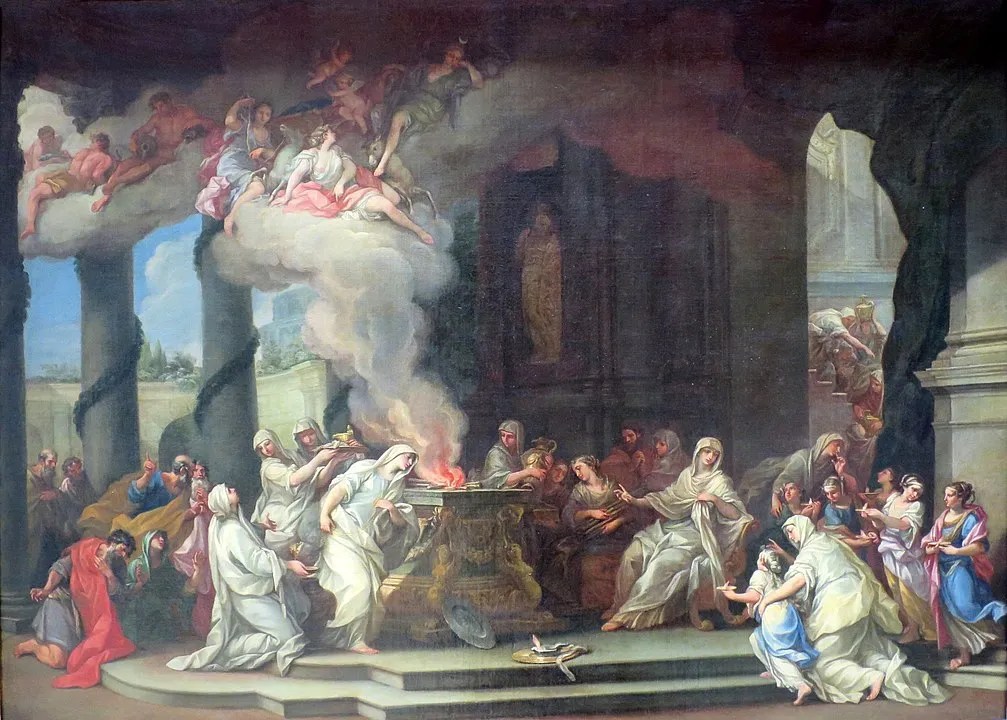
    Among the most sacred figures in Roman religion were the Vestal Virgins, priestesses of Vesta, goddess of the hearth. These women tended the eternal flame that symbolized Rome’s safety and spirit. But they also moved through a world scented with laurel, lavender, and olive oil, embodying a purity that extended beyond the physical to the spiritual—and even to the olfactory. Their lives were steeped in ritual, and scent was a quiet but constant companion.

    Even in death, Romans turned to fragrance. Funerals were drenched in scent—perfumed water to wash the body, aromatic oils to anoint it, scented cloths for wrapping. Incense smoke rose with the prayers of the mourners, guiding the soul to the next world. In Roman belief, the journey to the afterlife should begin not with fear, but with fragrance.

    Beyond public rites, household altars also carried the scent of devotion. Families burned small offerings of incense or dripped sacred oils onto miniature shrines honoring the Lares and Penates—guardian spirits of the home. These everyday acts were simple but deeply scented gestures of faith and protection.

    Scent even found its place in more mystical corners of Roman life—omens, love charms, healing rituals. People wore perfumed amulets or burned special herbs to invite good fortune or keep away illness. In Rome, to scent something was to mark it as meaningful—an act of reverence, memory, or transformation.

    In a world where words faded and statues crumbled, fragrance lingered. It danced in the air long after the ceremony ended. It was invisible, yet unforgettable.

    Because in Rome, worship wasn’t just seen or heard—it was smelled.

    Coming Next : Fragrance and the Trade of Empire

  • Fragrance in Everyday Life

    Part 3 of the “Scent and the Roman Empire” Series.

    If power in Rome was scented with opulence, then daily life was perfumed with ritual. For the average Roman—especially those of the upper class—scent wasn’t a luxury pulled out for special occasions. It was a rhythm of daily life, as essential as bread and wine.

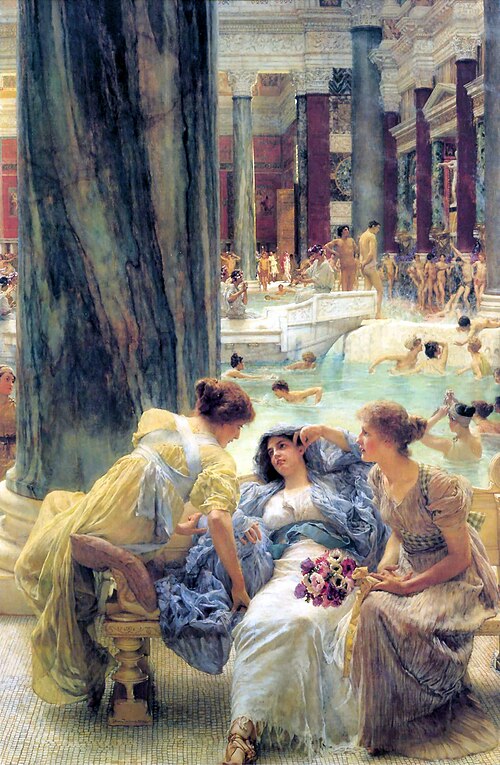
    The day often began with a visit to the public baths, the thermae. These were not merely places for washing but centers of social life and grooming culture. After soaking, scrubbing, and steaming, bathers would finish by anointing themselves with unguents, fragrant oils tailored for different parts of the body. Specialized slaves called unctores assisted in applying these perfumes, rubbing them into the skin to both nourish and scent it. The fragrances lingered long after the bath—announcing a person’s status, cleanliness, and even sensual appeal.

    Roman women relaxing in an ancient bathhouse, engaging in beauty and fragrance rituals, surrounded by classical architecture and water.
    Roman women at the baths, indulging in beauty and fragrance rituals — a visual glimpse into the scented daily life of ancient Rome. Image courtesy of AncientTouch.com, licensed under CC BY 2.5.

    For Roman women of means, fragrance was a key element of their beauty regimen. Many owned elaborately decorated unguentaria, small glass or ceramic bottles designed to hold their personal blends of perfumed oils. Recipes varied—some included rose and cinnamon for warmth, others mixed nard and saffron for an exotic allure. These oils were not just applied to the skin but to hair, clothing, bed linens, and even sandals. Some women perfumed their walls and curtains, while others added scent to furniture lacquer.

    Fragrance even extended to pets and possessions. There are accounts of perfumed collars for dogs, and of wealthy Romans scenting their wine or using fragrant garlands at banquets to elevate the mood. Aromatic sachets were placed in drawers and storage chests to keep clothing scented, and seasonal perfumes were rotated much like wardrobes today.

    Scent also played a role in romantic and social life. A person’s fragrance—or lack thereof—could affect their desirability. The poet Martial mockingly writes of guests who arrived at dinner parties with the stench of sweat and wine, rather than sweet myrrh and spikenard. In contrast, someone who smelled of distant, rare spices was immediately associated with sophistication, wealth, and global reach.

    In a world without modern hygiene products or air fresheners, the use of scent was deeply strategic. It masked, enhanced, enchanted—and it marked identity. Romans knew that fragrance wasn’t just about smelling good. It was about being remembered.

    In every corner of the Roman home and body, scent had a place.
    The empire did not just rule the known world—it perfumed it.

    Coming Next: Fragrance and the Divine

  • The Future of Anti-Aging – Adaptogens, Epigenetics & Sustainable Innovation

    What if aging wasn’t just fate—but something you could actively influence?

    A New Chapter in Anti-Aging

    For most of history, we treated aging as a slow, irreversible decline.
    But modern science—and traditional wisdom—are telling us something radically different:

    Aging is plastic. It can be influenced, slowed, even partially reversed.

    And nature has been offering tools all along.
    We’re just now learning to decode and optimize them.

    1. Epigenetics – Rewriting Your Skin’s Biological Story

    Epigenetics is the science of how genes are expressed—and crucially, how that expression can be modified by environment, lifestyle, and skincare.

    • Your DNA may be fixed, but how your cells “read” that DNA?
      → That’s changeable.
    🧬 How Epigenetics Affects Skin Aging:
    • Environmental stress turns on inflammatory genes
    • UV and pollution trigger collagen-degrading enzymes (MMPs)
    • Hormonal shifts silence youth-preserving genes

    But with the right interventions—botanical actives, adaptogens, nutrients—
    we can activate skin longevity genes, such as:

    • SIRT1 (linked to repair & metabolism)
    • FOXO3a (cell stress resilience)
    • Klotho (the “anti-aging gene”)

    👉 To explore how botanical ingredients can help modulate these pathways and support youthful skin from within, read The Science of Aging and the Power of Botanicals.

    2. Adaptogens – Nature’s Stress Whisperers

    Adaptogens are plants that help the body (and skin) adapt to stress, both internal and external.
    They don’t overstimulate or sedate—they restore balance, which is exactly what aging skin needs.

    🌱 Top Adaptogenic Botanicals for Skin & Longevity
    PlantRoleSkin Benefits
    Rhodiola roseaEnergy & cell protectionFights fatigue, boosts glow
    AshwagandhaCortisol balanceReduces skin reactivity
    Schisandra chinensisLiver & detoxBrightens dull skin
    Holy Basil (Tulsi)Hormonal modulationSoothes inflamed skin
    Reishi MushroomImmune modulationImproves elasticity, reduces irritation

    Many of these herbs activate cellular defense pathways like Nrf2, and support mitochondrial longevity.

    💊Inner Beauty Meets Epigenetics
    • Resveratrol and quercetin: activate SIRT1 (skin longevity)
    • Astaxanthin: mitochondrial antioxidant that protects DNA
    • NAD+ boosters (e.g., niacinamide, NMN): support cellular energy
    • Marine collagen + adaptogens: rebuild & rebalance from within

    This is the future: customized, biologically intelligent beauty.

    3. Sustainability – Ethical, Effective, and Long-Term

    True beauty innovation today must answer three questions:

    1. Does it work?
    2. Is it safe?
    3. Is it sustainable—for people and the planet?

    That’s why eco-extraction, biotechnology, and wild-harvested ingredients are on the rise.

    Look for:

    • Biotech-sourced peptides (lab-grown, not animal)
    • Upcycled plant actives (e.g., grape skin, coffee husk)
    • Waterless skincare formats (e.g., powders, solid serums)

    🧴 Skincare Meets Smart Science

    Brands are already formulating with:

    • Epigenetically active peptides
    • Mushroom-based stress-calming complexes
    • Prebiotic-rich ferments for the skin microbiome


    The future of anti-aging isn’t just about “not getting old.”
    It’s about staying well, inside and out, for longer.

    This is beauty redefined—not a reversal of time, but a partnership with time.

    And in that partnership, plants, science, and soul all have a role to play.

    🌿 This post is part of the “Nature’s Timeless Secrets” anti-aging series.
    Episode 1: The Science of Aging and the Power of Botanicals
    Episode 2: The Power of Polyphenols – Nature’s Top Antioxidants for Youthful Skin
    Episode 3: Phytoestrogens and Skin – Nature’s Hormone Helpers for Firmness and Radiance
    Episode 4: Inflammaging & Turmeric – Calming Skin Aging from the Inside Out
    Episode 5: Centella Asiatica – The Asian Botanical That Rebuilds Skin from the Inside Out
    Episode 6: The Ocean’s Secret – Marine Botanicals and Minerals for Long-Term Skin Vitality
    Episode 7: The Future of Anti-Aging – Adaptogens, Epigenetics & Sustainable Innovation 

  • Fragrance and Power

    Part 2 of the “Scent and the Roman Empire” Series

    “Scent was not only a pleasure of the body, but a message to the world.”

    In ancient Rome, scent wasn’t just a matter of pleasure—it was a political statement. The fragrances worn, burned, and bathed in by the Roman elite carried as much meaning as their togas, villas, or marble busts. In the hands of Rome’s most powerful figures, scent became a subtle but potent tool of persuasion, diplomacy, and dominance.

    One of the most legendary examples of this olfactory diplomacy is the relationship between Julius Caesar and Cleopatra. When the Egyptian queen first sailed to meet Caesar, historical accounts tell us that her arrival was heralded not just by music and finery, but by the overwhelming scent of incense and exotic oils that perfumed the sails of her barge. Cleopatra had mastered the use of fragrance as a sensory weapon—one that conveyed wealth, mystery, and divine allure. For Roman observers, the air around her was more than scented—it was charged with meaning, seduction, and power.

    Caesar, a master of public image himself, understood the significance of such theatrics. Though Romans traditionally praised stoicism and modesty, the upper class increasingly embraced luxury as a sign of dominance. Fragrance, imported at great cost from the East, became a public display of imperial reach. To smell of frankincense or myrrh was to smell like the empire itself—vast, powerful, and irresistible.

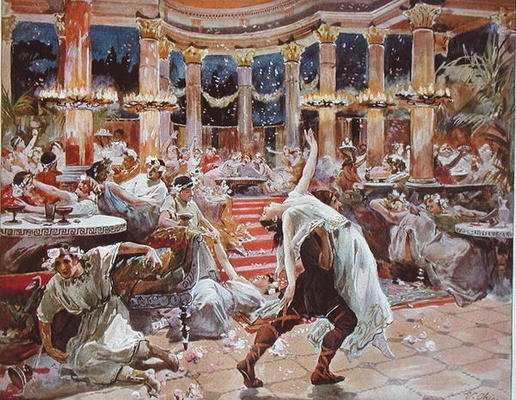
    Later emperors would take this to the extreme. Nero, infamous for extravagance, was said to have perfumed banquet halls with ceilings that rained down rose petals and unguents. His palace was designed with pipes that released fragrant vapors into the air, turning architecture into olfactory theater. His use of scent was not just indulgent; it was political—declaring his divine status through overwhelming sensory experience.

    Even the rituals of the Roman Senate and state religion were filled with fragrant symbolism. Incense was burned during official ceremonies not only to honor the gods but to create an atmosphere of solemnity and control. The more lavish the scent, the more powerful the presence.

    Among aristocrats, the use of rare and complex perfumes became a competitive art. Recipes were closely guarded, and perfumers gained celebrity status in certain circles. Fragrance was worn not only on the body, but in rings with secret scent compartments, in hair oils, and even mixed into wine. It was whispered that you could tell a man’s political aspirations by the way he smelled—and whether his fragrance lingered after he left the room.

    In Rome, power didn’t just speak. It perfumed.
    It left behind a trail—not just of influence, but of scent.
    And in a city obsessed with legacy, to be remembered by your fragrance was as enduring as any statue.

    Coming Next: “Fragrance in Everyday Roman Life”