• Part 2 of the “Chronicles of Scent in Antiquity” Series

    “Each part of the day belongs to a god. And when the sun sets, the realm of Osiris begins.”
    Temple inscription, Ptolemaic Period

    A Fragrant Offering for the Dusk

    The setting sun in ancient Egypt did not merely mark the end of the day—it signaled a shift in the spiritual world. Day belonged to the sun god Ra, but night was the domain of Osiris, god of the afterlife and rebirth. At this liminal moment, when light gave way to darkness, a priest stepped into the inner sanctum, lit a small flame, and began to burn Kyphi.

    This was not casual incense. Kyphi was reserved exclusively for the evening ritual, known in Egyptian as “senetjer”, or “to make divine.” It was a central element of the daily temple liturgy, performed three times a day: at dawn, noon, and sunset. But only at sunset was Kyphi used—its rich, layered scent meant to prepare both the gods and the humans for the transition into night.

    Inside the Temple: Precision, Purity, and Perfume

    Egyptian temples were not public places of worship but homes for the gods, tended by an elite priesthood. Each day, priests performed a strict sequence of rites, including cleansing statues of deities, anointing them with oils, dressing them in fine linens, and offering food, drink, and incense.

    Before entering the sanctuary, the priest had to undergo ritual purification—including bathing, shaving body hair, and donning clean linen robes. As the final act of devotion, incense was burned to please the god’s senses and spiritually “seal” the ritual.

    Kyphi, with its rare ingredients and complex preparation, was a fragrance of the highest order, reserved for these most sacred moments. The thick, sweet-smoky aroma was believed to:

    • Purify the air and space
    • Appease deities and invite their presence
    • Elevate the soul and prepare for dreams or visions

    The Sunset Liturgy: A Sacred Schedule

    In temples like those at Karnak, Dendera, and Edfu, the daily ritual followed a consistent rhythm:

    1. Dawn – Opening of the sanctuary, burning of frankincense
    2. Midday – Offerings of myrrh and fresh linens
    3. Sunset – Kyphi incense burned in silence and reverence
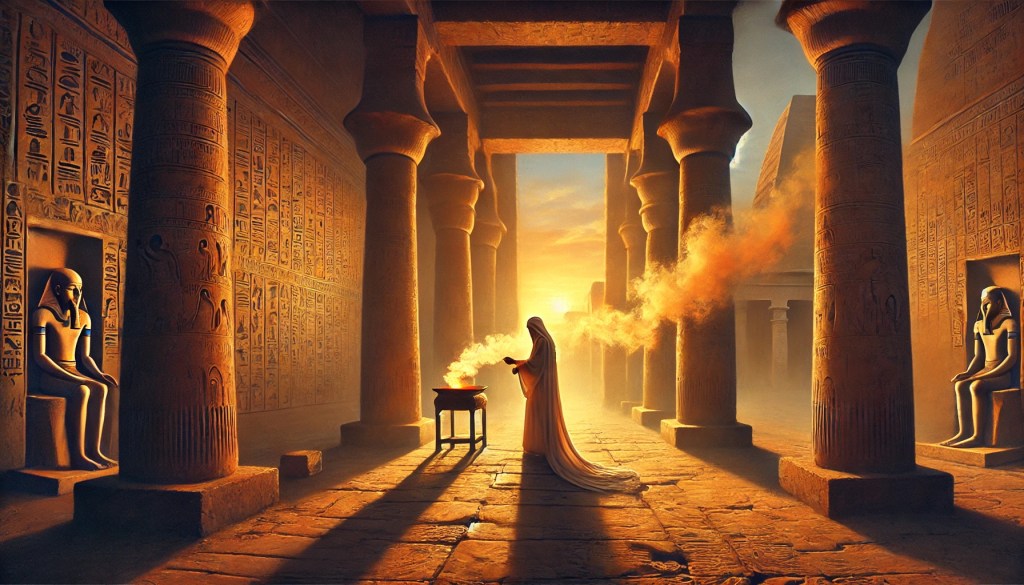
    “Sunset incense ritual inside the Temple of Edfu, where a priest offers Kyphi to the gods. This sacred act, performed at dusk, marked the transition from the realm of Ra to that of Osiris. The rising smoke symbolized prayers ascending to the divine.”

    Plutarch, the 1st-century CE philosopher, wrote that Kyphi’s association with evening reflected its relaxing and cleansing nature. He described it as:

    “…a compound that promotes sleep and serenity, useful after the business of the day has passed.”

    This aligns with how the Egyptians may have viewed Kyphi—not only as a divine offering, but as a way to close the day with spiritual balance and peace.

    Smoke as a Pathway to the Divine

    To the ancient Egyptians, scent had a direction—smoke rose upward, carrying prayers, thoughts, and life force toward the heavens. The temple was built as a microcosm of the universe, and incense acted as the bridge between worlds.

    Burning Kyphi at sunset symbolized a shift into the mystical, nocturnal realm—a time of dreams, death, and renewal. In this sense, it was more than scent; it was theology in vapor form.

    Even the word for incense (senetjer) meant “to make divine.” The act of burning Kyphi was not just ritual—it was a transformation, of space, time, and spirit.

    From Ritual to Rhythm: Why This Still Matters

    Understanding Kyphi’s role in temple rituals allows us to see fragrance not just as aesthetic, but existential. It reveals a civilization that believed scent could order time, elevate consciousness, and invite divinity.

    In an age where we rush through our days, the ancient Egyptians remind us:
    The day is not complete without sacred closure.
    Kyphi was that closure—a breath between this world and the next.

    Coming Next:
    Part 3 – “Kyphi Reborn: How Modern Perfumers Recreate a Lost Sacred Blend”

  • Part 1 of the “Chronicles of Scent in Antiquity” Series

    “The gods rejoice in sweet-smelling woods and resins offered in the temple.”
    Paraphrased from Papyrus Harris I, 20th Dynasty Egypt

    Introduction: A Fragrance Beyond Time

    Today, we associate perfume with personal pleasure, luxury, or ambiance. But in ancient Egypt, fragrance was sacred—a medium to communicate with gods, heal the body, and guide the soul in death. Among all ancient scents, one stands out as a symbol of divine and ritualistic significance: Kyphi.

    Used in temples during sunset rituals, Kyphi was believed to purify the space, honor the gods, and spiritually uplift the priesthood. It was more than incense—it was a spiritual and medicinal formula crafted with intention.

    Historical Sources: Echoes from the Past

    While no single formula survives intact, Papyrus Harris I, Ebers Papyrus, and writings by Plutarch and Dioscorides offer glimpses into the use and meaning of Kyphi.

    In Papyrus Harris I, King Ramesses III lists valuable temple offerings—including incense and resins—provided to please the gods and sustain temple rituals. Though the exact poetic phrase “At night, the gods breathe in its essence…” is not a literal quote, it reflects a sentiment consistent with ancient texts that describe fragrance as pleasing to the divine.

    Plutarch, writing centuries later, described Kyphi as:

    “A compound of sixteen substances… conducive to health, sleep, and divine dreams.”
    Plutarch, On Isis and Osiris

    What Went Into Kyphi?

    Though recipes varied, the following ingredients appeared frequently:

    • Frankincense – sacred smoke for rituals and cleansing
    • Myrrh – purification, antiseptic qualities
    • Cinnamon, cassia – warming, aromatic spices
    • Resins (such as pine, juniper, or henna) – deep balsamic base
    • Honey and wine – used to bind and ferment the mixture
    • Raisins and dates – natural sugars, fermentation agents
    • Herbs and spices like cardamom, galbanum, calamus, and violet leaf

    Preparation was a slow, deliberate process. Ingredients were macerated in wine, ground into fine powders or pastes, then mixed with honey. The resulting blend was left to mature—sometimes for weeks—before being shaped into pellets or cakes for burning.

    Ritual and Healing: The Functions of Kyphi

    Kyphi was primarily used during sunset rituals in temples, representing the passage into night and the divine realm. Burning Kyphi was seen as an offering to gods such as Ra and Osiris.

    According to Plutarch and later Greek sources, Kyphi was also used medically—as a breath freshener, remedy for insomnia, and digestive aid. Some modern studies of Kyphi-like recipes have confirmed calming and antibacterial properties in its ingredients, supporting its traditional use in ritual purification and healing.

    Kyphi may have also been used in dream incubation rites—rituals aimed at receiving divine messages during sleep, an early form of what we now recognize as meditative aromatherapy.

    Modern Reconstructions: Reawakening the Ancient Scent

    Scholars and artisans have attempted to reconstruct Kyphi based on ancient texts. Universities and independent perfumers alike have experimented with ratios and ingredients described by Plutarch, Dioscorides, and temple inscriptions.

    The result? A scent often described as:

    “Deep, resinous, sweetly smoky—with the feeling of sacred woodlands at dusk.”

    These reconstructions aren’t exact replicas but interpretive recreations, offering us a sensory bridge to the ancient world.

    Why Kyphi Still Matters

    Kyphi is more than a perfume of the past. It reflects how the ancient Egyptians wove spirituality, medicine, ritual, and art into a single act: burning incense. Through Kyphi, we glimpse a civilization that believed fragrance had power—not just over the senses, but over the soul.

    Upcoming in this Series:
    Part 2 – “When the Gods Slept, Kyphi Burned: Ritual Rhythms in the Temple”

  • The Origins of Perfume in Ancient Egypt
    The history of scent is, in many ways, the history of humanity itself.
    Thousands of years ago, ancient civilizations regarded fragrance not merely as a pleasant aroma but as a sacred bridge between humans and the divine. Among them, ancient Egypt stands out as the birthplace of sophisticated aromatic culture.

    Cleopatra: Ruler of Scent and Power
    Cleopatra was more than a beauty—she was a master of strategy.
    She used scent as a political tool, turning fragrance into a symbol of power and allure.
    Historical accounts describe her arrival to meet Julius Caesar or Mark Antony as a sensory spectacle. She perfumed her ship’s sails with rose oil so intensely that the scent reached the harbor before she arrived.
    Modern researchers suggest her perfumes may have included a blend of rose, jasmine, lavender, cinnamon, and myrrh—all natural ingredients that remain essential in modern aromatherapy. Among them, frankincense and myrrh are particularly valued for their spiritual and therapeutic qualities.

    Public Domain/Alexandre Cabanel

    Fragrance as Cultural Heritage
    From Egypt to Mesopotamia, India, Persia, Greece, and Rome, fragrances played roles in ceremonial rituals, medicine, beauty, and emotional wellness.
    These traditions directly inform modern aromatherapy, which blends ancient knowledge with scientific research.
    For instance, frankincense has been shown to exhibit anti-inflammatory and immune-boosting properties, while myrrh is valued for its antimicrobial and wound-healing benefits.

    Ancient Wisdom for Modern Life
    Modern perfumes and essential oils are not just fashion statements—they’re part of an ancient legacy.
    Scent has long been a tool to influence emotion, memory, and even spiritual consciousness.
    Today, the global fragrance and wellness industries are booming, rooted in these timeless traditions.

    At Wellnavia, we aim to reconnect nature and humanity through the power of scent, bridging historical rituals with modern wellness practices.
    In our next post, we’ll explore fragrance in ancient Greece and Rome, where scent became a symbol of beauty, philosophy, and social identity.

  • Hello, everyone! I am Stella, a PhD in Cosmetic Engineering and a seasoned expert with over two decades of deep exploration in herbal medicine, aromatherapy, and skincare science. Today, I’m excited to invite you to a fascinating journey where beauty and wellness unite through the transformative power of scent.

    Scent goes beyond just pleasant fragrances—it holds the incredible power to enhance our emotional well-being, reduce stress, maintain youthful and healthy skin, and elevate our overall quality of life. Through this blog, we will delve deeply into the captivating science of aromas, uncovering secrets to genuine beauty and sustainable wellness.

    In the upcoming posts, you’ll explore intriguing topics such as:

    • The history and cultural significance of fragrances dating back to ancient civilizations
    • The hidden powers of botanical medicines gifted by nature and practical ways to use them
    • Effective aromatherapy practices for stress relief and improved skincare
    • Scientific insights and practical applications of globally celebrated K-Beauty
    • Real-world anti-aging solutions for beauty, health, and longevity

    Additionally, through forthcoming PDF e-books and comprehensive online courses, you’ll gain access to practical strategies that can be effortlessly implemented at home.

    I warmly welcome you to this special journey dedicated to enhancing beauty and wellness through scent. Step forward into a world that can truly transform your life.

    I’m delighted and excited to have you along for this enriching experience. See you in the next post, where our exploration of fragrance and wellness truly begins.

    Wishing you a beautiful and aromatic day,

    Warm regards, Stella